
Overcoming Empathy Fatigue in Youth Work: Approaches in Self-Care for Youth Workers
A mindfulness and self-compassion training week in Castlebaldwin, Co. Sligo, Ireland, 7–13 April 2026
Intention
This training existed because care work does not scale cleanly. In youth work, the same relational intensity that makes the work meaningful is also what slowly accumulates as pressure: stories carried home, boundaries stretched thin, the quiet expectation of emotional availability that rarely pauses.
Across partner countries, we were hearing the same language return in different accents — exhaustion that did not fully resolve with rest, a growing difficulty in staying emotionally present without feeling depleted, and a subtle distancing that practitioners themselves often described with discomfort. Not burnout as an event, but something more continuous: empathy turning heavy.
The question we carried into Castlebaldwin was not how to make youth workers “more resilient” in a generic sense, but rather: what does it take to remain emotionally available to young people without losing contact with oneself? And more quietly: what if the sustainability of youth work is not a structural add-on, but a daily inner practice shaped by how we relate to stress, responsibility, and care?
What happened
The week unfolded in a rhythm that gradually slowed the group down. People arrived carrying the texture of their work — tiredness that sat behind the eyes, a certain professional alertness that does not switch off easily. The first days were still full of talking, explanation, comparison between national contexts. It felt like the group was arriving not just in Ireland, but into itself.
The shift was not dramatic. It happened in repetition. Morning practices that asked participants to notice breath without trying to fix anything. Exercises that turned attention to simple sensory detail — ground, space, sound, memories. At first, some participants laughed quietly at how difficult it was to “do nothing in a structured way.” Then, over time, something softened in that resistance.
One of the most visible thresholds came during a guided reflection on difficult encounters with young people. Instead of analysis, participants were invited to stay with bodily sensation. The room became noticeably quieter than in previous sessions. Some people kept their eyes open, focusing on a fixed point. Others looked down. What changed was not the content of their stories, but the pace at which they were held.
By mid-week, informal conversations during breaks shifted tone. Less emphasis on performance or professional identity, more on fatigue, boundaries, and small practices of recovery. The residential format mattered here: shared meals, unstructured evenings, the presence of others without the requirement to “be on.”
By the final day, the group did not feel transformed in a performative sense. It felt steadier. Less urgency in speech. More pauses before answering. A sense that experience had not been resolved, but slightly re-situated.
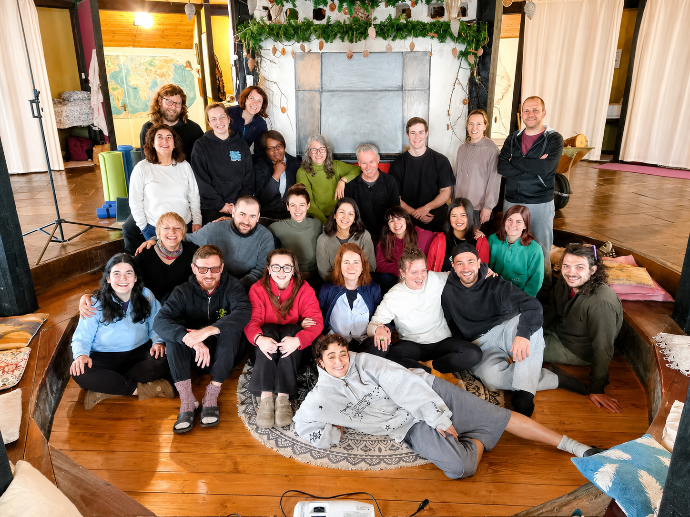
Aprile 2026, Castelbaldwin (Ireland)
What we learned
Key points from the participants
Across the group, the training consistently shifted empathy fatigue and burnout from abstract concepts into lived, recognisable processes. Participants described a growing ability to identify early signs of depletion — not only in theory, but in their own bodies, patterns, and decision-making in youth work practice.
A central learning was the distinction between empathy and compassion, which many participants named as transformative. Empathy was experienced as deeply absorbing and sometimes exhausting, while compassion introduced the possibility of remaining connected without becoming depleted. This distinction was repeatedly linked to sustainability in daily work with young people.
Another key outcome was the development of self-awareness and boundary recognition. Participants reported becoming more conscious of their limits and more able to notice when they were moving into overextension. Several described this as a shift from automatic over-giving toward more intentional presence.
The training also supported understanding of stress and nervous system regulation, making abstract stress responses more tangible and actionable. Concepts such as “zones of regulation” and embodied awareness of stress states were highlighted as practical tools that participants could revisit in real situations.
Importantly, many participants emphasised that the learning was not only cognitive but also experiential and embodied. Meditation, reflection, and group processes were described as essential in allowing insights to emerge, rather than simply being explained.
Finally, a strong theme emerged around self-compassion as a corrective experience. Several participants linked the training to a reduction in self-criticism and an increased capacity to treat themselves with kindness — a change they directly connected to improved wellbeing and professional sustainability.
What we learned
Key points from the partner organisations
First, we learned that empathy fatigue is rarely about lack of knowledge. Participants already knew many of the frameworks for self-care. What was missing was not information, but permission and practice space to integrate it into lived rhythm.
Second, we saw that mindfulness-based approaches only become meaningful when they are not treated as performance skills. The moment practices became something to “do correctly,” tension returned. When they became exploratory and non-evaluative, engagement deepened.
Third, we learned that residential learning environments matter more than often acknowledged. The informal spaces — meals, corridors, evenings — were not peripheral. They were where integration happened.
Fourth, we noticed a tension between individual coping and structural pressure. While the programme strengthened personal resources, it also surfaced how much of the strain in youth work is systemic, not individual. Several participants named this explicitly.
Finally, we learned something about facilitation itself: holding space for care fatigue requires facilitators to regulate their own urgency. The pace of delivery became part of the content.
What we are taking forward
Locally, partners intend to integrate short “micro-practice” formats into ongoing training cycles — not as standalone wellbeing modules, but as embedded pauses within existing professional development structures.
At network level, this activity opens a clearer link to policy conversations around workforce sustainability in youth work. If emotional labour is a core condition of the sector, then resilience cannot remain an individual responsibility alone. The insights from this training contribute to emerging work on quality standards for sustainable practice environments, including implications for funding structures that currently prioritise output over practitioner wellbeing.
There is also a clear opening for revisiting how “competence” is defined in youth work training frameworks: not only as skills and knowledge, but as the capacity to remain in relationship without self-exhaustion.
Voices
“I realised I was already experiencing empathy fatigue without knowing what it was. Now I can recognise it earlier and respond differently.”
“The difference between empathy and compassion is one of the most important things I’ve learned. Compassion allows me to stay helpful without burning out.”
“I never had much self-compassion before. This training changed that — I am now much kinder to myself.”
“Instead of trying to stop my thoughts, I was invited to feel them. That shift alone was very powerful for me.”
“It gave me clarity about prevention — about the small steps I need to take so I don’t overwork myself.”
“I became much more aware of my limits. I don’t need to be available for everyone all the time — first I need to be present for myself."
Partners
Leitrim County Childcare Committee (CCC)
It is part of a national network of organizations that supports youth work and childcare practitioners through professional development training, mentoring, and evidence-based educational initiatives aimed at enhancing the quality of practice, practitioner wellbeing, and engagement with young people.

Activating leadership potential
ALP is a European network of professionals dedicated to fostering resilient, inclusive, and emotionally intelligent leadership through mindfulness-based, trauma-sensitive, and experiential learning approaches that support wellbeing, sustainable social change, and the development of authentic leadership in youth work, education, and community settings.
Élményakadémia Közhasznú Egyesület
Élményakadémia (EA KHE) is a Hungarian non-formal education organization that empowers young people and youth workers through experiential learning, outdoor education, and inclusive development programmes focused on personal growth, social participation, sustainability, and support for marginalized youth.


P.E.CO. - Progetti europei di cooperazione
P.E.CO. is an Italian youth organization that promotes international mobility, non-formal education, and intercultural learning through Erasmus+ and European Solidarity Corps projects that foster inclusion, active citizenship, emotional wellbeing, and personal development among young people, especially those with fewer opportunities.